Introduction: A Country at the Turning Point of Opportunity
There is a moment in every market cycle when bold decisions define the future. For Cameroon, that moment is now. In 2026, a new Code of Investments, a reformed mining sector, a booming digital economy, and a government-backed agro-industrial push are converging to create some of the most compelling investment opportunities in Cameroon in decades.
This is not abstract promise. It is lived reality for the entrepreneurs launching cocoa processing plants in Kribi, the fintech founders scaling mobile payment platforms in Douala, and the international mining companies breaking ground on bauxite reserves in the north. Every sector tells a story of transformation, of a country determined to convert raw potential into structured, lasting wealth.
But here is the truth that separates savvy investors from spectators: investment opportunities in Cameroon are not self-executing. They reward purpose, preparation, and the willingness to act with intention. This article is your compass. It maps the terrain, names the sectors, cites the numbers, and proposes a clear, ethical, and sustainable path forward. If you are serious about growing your capital in Sub-Saharan Africa, read on — because the window is open, and those entering first will define the next decade.
What Do We Mean by Investment Opportunities in Cameroon?
Investment opportunities in Cameroon refer to the specific economic sectors, projects, and market conditions that offer above-average returns for capital deployed in the country today.
Cameroon is often called “Africa in miniature” — and for good reason. It holds tropical forests, coastal access, oil and gas reserves, fertile agricultural land, and a youthful, growing population of over 27 million people. The International Monetary Fund (IMF) projects GDP growth of 3.3% in 2026, rising beyond 4% by 2028, driven by mining expansion, energy infrastructure, and digital services.
What makes this moment particularly powerful is a convergence of three forces:
- Regulatory reform: The revised Investment Code (Ordinance N°2025/002, July 2025) offers expanded tax and customs incentives across priority sectors.
- Public investment: The 2026 Finance Law allocates 2,026 billion FCFA (~USD 3.4 billion) in public capital expenditure, pulling private investment with it.
- Structural demand: A housing deficit of 2.5 million units, chronic energy undersupply, and an under-transformed agricultural sector all represent unmet needs — and unmet needs are where business is born.

Why 2026 Is the Year to Act
A Reformed Business Climate
The Cameroonian government has made clear signals. In July 2025, a landmark ordinance revised the national Investment Code for the first time in over a decade. This new framework:
- Grants up to 30% tax exemptions in agro-pastoral sectors.
- Offers zero customs duties on technology equipment for certified startups.
- Extends fiscal advantages to renewable energy equipment.
- Strengthens the Investment Promotion Agency (API) as a one-stop shop for investors.
These are not promises. They are signed laws, already in force.
A New Budget Anchored in Growth
The 2026 national budget stands at 8,816 billion FCFA — the largest in the country’s history. More than 2,000 billion FCFA is earmarked for public investment. Roads, ports, energy, water, health facilities, and schools are all in the pipeline. Each public project creates a procurement chain. That chain is where private business thrives.
A Maturing Ecosystem
Cameroon now hosts functional innovation hubs, incubators, and accelerators. Google’s 2026 “AI First” Accelerator cohort is open to Cameroonian startups. The Kribi Port Industrial Zone (KPIZ) — a 4,000-hectare industrial platform valued at 521 billion FCFA — launched on February 26, 2026. These are ecosystem signals, not isolated events.
The Eight Most Promising Sectors — An Honest Assessment
1. Agribusiness and Agro-Industry: The Foundational Opportunity
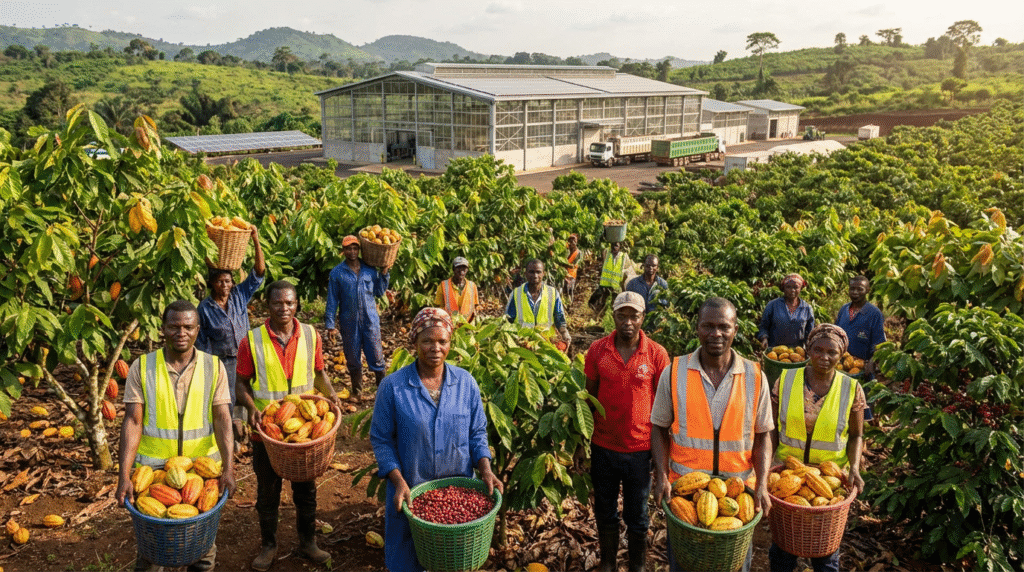
Agriculture employs 62% of Cameroon’s active population. Yet over 80% of its cocoa, coffee, and palm oil are exported raw. The margin of local transformation is enormous — and barely touched.
Cameroon is the 5th largest cocoa producer in the world and Africa’s top robusta coffee producer. In 2026, the transformation race is accelerating:
- SIC Cacaos (Barry Callebaut subsidiary) raised its capital to 6.885 billion FCFA, doubling down on local processing.
- Opalm acquired the Socapalm plant in Eséka, consolidating the palm oil value chain.
- Two Cameroonian coffee roasters won international distinctions at the African Taste of Harvest 2026 in Addis Ababa.
- The government’s 2024–2026 agricultural plan mobilized 250 billion FCFA in its first year alone.
The agro-industrial zones around Kribi, Mbam, Sanaga, and Lékié offer equipped land and infrastructure. Investors willing to process locally — chocolate, refined oils, coffee extracts, cassava derivatives — will find both demand and incentives.
The Human Dimension of Agricultural Investment
This sector is not just about commodities. It is about the 62% of Cameroonians who depend on the land. Purposeful investment here means partnering with cooperatives, supporting women-led farming initiatives, and integrating climate-smart technologies like blockchain traceability and precision irrigation. These are not charity additions — they are what makes an agro-business sustainable and resilient over time.
2. Energy and Renewable Transition: Powering the Economy
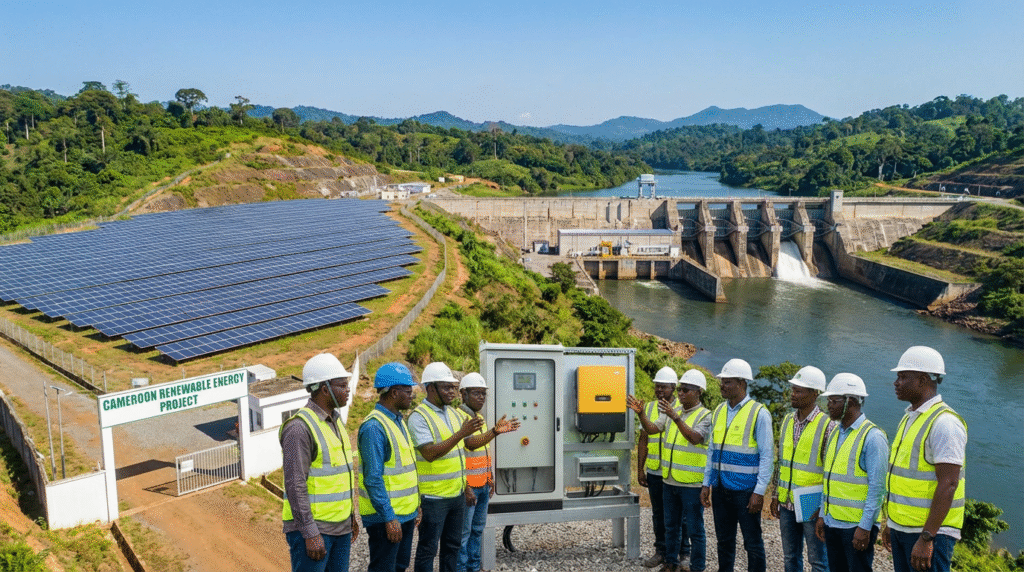
Energy is both a bottleneck and an opportunity. Power cuts cost Cameroonian businesses an estimated 3–5% of annual revenues. Solving that problem is a business model.
The national government re-nationalized ENEO (the main electricity distributor) in February 2026, acquiring 95% of the capital for 78 billion FCFA. The state-backed National Energy Compact targets 3,000 MW of installed capacity by 2030.
Key sub-sectors and their status in 2026:
| Sub-Sector | Capacity / Status |
|---|---|
| ☀️ Solar PV | 250 MW in deployment (Maroua, Guider) |
| 💧 Hydroelectricity | Nachtigal (420 MW) — 30% boost to national grid |
| 🌬️ Rural Mini-Grids | PPP model, strong public demand |
| ♻️ Biofuels | Equipment defiscalized from 2026 |
| 🔋 Energy Storage | Emerging market for industrial clients |
Investors in solar, off-grid rural electrification, and energy storage will find both a regulatory tailwind and a massive unmet market.
3. Mining and Natural Resources: A Historic Entry Point
The mining sector contributes only 2.1% of GDP today, but the target is 8.5% by 2031. Fifteen projects are entering production phase. This is a once-in-a-generation repositioning.
Three flagship projects define the 2026 landscape:
- Minim-Martap Bauxite (Canyon Resources): 144 million tonnes of reserves, 51.2% Al₂O₃ grade. Investment: $96 million. Pilot shipments planned for Q3 2026.
- Mbalam-Nabeba Iron Ore: Initial truck transport to Kribi port, rail infrastructure under development.
- Grand Zambi Iron: Five local banks authorized to raise 41.2 billion FCFA from the BEAC to finance extraction.
A new regulatory clean-up — revoking non-compliant permits as of February 20, 2026 — has cleared space for serious, compliant operators.
4. Logistics, Ports, and Infrastructure: The Central African Hub
Cameroon’s ports serve three landlocked neighbors — Chad, the Central African Republic (CAR), and soon the Democratic Republic of Congo (DRC). This gives its logistics sector a captive, growing market.
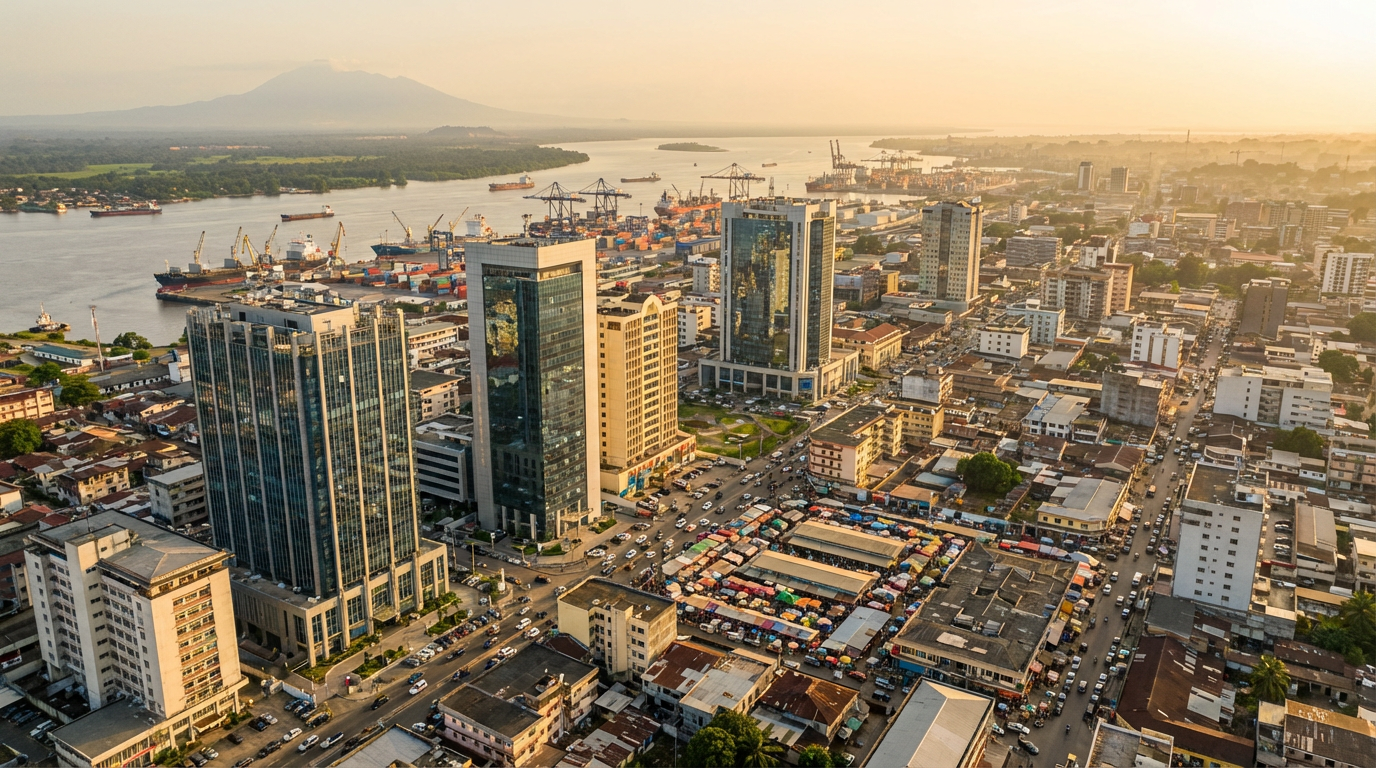
The Kribi Port Industrial Zone (KPIZ) — 4,000 hectares, 521 billion FCFA — is one of the continent’s most ambitious logistics-industrial projects. Globally, AD Ports Group and CEVA Logistics have already invested in Douala. The Port of Douala itself is moving toward full digitalization by September 2026, reducing costs and clearance times dramatically.
Warehousing, cold storage, freight forwarding, and e-commerce distribution platforms are all underserved niches within this growing hub.
5. Digital Economy, Tech, and Fintech: The Youth Dividend
President Biya allocated 50 billion FCFA to youth entrepreneurship and digital innovation in his December 2025 New Year address. Certified tech startups now pay 0% customs duty on equipment. These are direct financial incentives, not abstractions.
The ecosystem is already producing results. Artificial intelligence tools deployed in Douala and Yaoundé saved 136,000 hours of urban commuter time in 2025 alone. Fintech startup CamPay is scaling mobile payment infrastructure rapidly. Healthtech platform Waspito is expanding telemedicine into underserved communities.
The 2026 Google AI First Accelerator has opened its cohort to Cameroonian startups, connecting local innovators to global mentors and capital networks.
Investors in fintech infrastructure, cybersecurity, edtech, and agritech will find a rapidly maturing market, a youthful population hungry for digital services, and a government actively clearing the runway.
6. Real Estate and Construction: Meeting Structural Demand
Cameroon has an urbanization rate of 56.5% in 2026 and a housing deficit of 2.5 million units. Only 3,585 social housing units were built in 17 years. The gap between demand and supply is structural — and structural gaps create durable business models.
In premium real estate, Bonanjo (Douala) commands €2,400–3,800 per square metre with 8–10% annual growth projected. In Yaoundé, districts like Bastos, Odza, Mendong, and Nkolbisson are experiencing rapid appreciation.
The 2026 public budget allocates 143 billion FCFA for schools and hospitals. Construction firms, materials suppliers, and real estate developers all benefit from this pipeline.
7. Healthcare and Pharmaceuticals: The Underserved Giant
Cameroon spends heavily on importing medicines and medical devices. Almost none are produced locally. That dependency is a risk for the government — and a market signal for investors.
The SND30 national strategy explicitly targets local pharmaceutical production, expanded hospital PPPs, and telemedicine coverage. Any investor building capacity in generic drug manufacturing, medical equipment distribution, or digital health tools is entering a protected, demand-rich market with limited competition.
8. Green Economy and Forestry: Long-Term, High-Impact Capital
The World Bank dedicated its entire 2025 Cameroon Economic Report to this theme: “L’Or Vert — Valorising Forests and Natural Capital.” Cameroon’s Congo Basin forests are among the world’s most carbon-dense. Carbon credit markets, sustainable forestry, and ocean-based (“blue economy”) initiatives are all emerging.
The 2026 Finance Law introduced new tax incentives for biofuels and clean waste management. Douala is opening urban waste pre-collection to SMEs and neighborhood committees — a direct market opening for green entrepreneurs.
A Real-World Story: How One Investor Found His Purpose in Cameroon
Consider the story of Alain, a Cameroonian diaspora entrepreneur based in Paris. For years, he watched the news from home with a mix of nostalgia and frustration. He saw the potential. He felt the distance.
In early 2025, he returned for the first time in seven years, attending the Kribi Port Industrial Zone launch preparations. What he found surprised him. Modern logistics infrastructure. A reformed investment code. A government actively courting private capital. A generation of young Cameroonians building tech companies, processing cocoa, and running fintech platforms.
He had come to observe. He left with a business plan — a cold-storage logistics company serving the KPIZ agro-export corridor. Within ten months, he had secured a lease in the industrial zone, a first contract with a palm oil processor, and a government-backed loan guarantee through the API.
Alain’s story is not exceptional. It is becoming the template. The investment opportunities in Cameroon are not theoretical. They are lived — by people who came with purpose, stayed with patience, and acted with intent.
“I stopped waiting for Cameroon to be ready. I realized Cameroon was waiting for people like me to come back with purpose.” — Alain M., founder, KribiCold Logistics
How to Invest in Cameroon With Purpose and Clarity
Step One: Define Your Sector and Your Why
Not every investor should enter every sector. Start by matching your expertise, your timeline, and your values to the right opportunity. Are you a builder? Real estate and BTP. A technologist? Fintech or edtech. A food entrepreneur? Agro-industry. An energy engineer? Renewables.
The investment opportunities in Cameroon are richest when the investor brings genuine expertise, not just capital. Cameroon has enough passive capital. What it needs are active, committed partners.
Step Two: Engage the API — Your Legal Gateway
The Agence de Promotion des Investissements (API) is Cameroon’s official investment facilitation body. It provides a one-stop shop for registration, licensing, incentive access, and project matching. Any investor entering the market should engage the API before spending a single franc on legal fees.
Step Three: Build Local Partnerships
Cameroon rewards those who partner locally. A Cameroonian co-founder, a local distribution network, or a community development commitment does not just reduce risk — it builds the social license to operate that external capital alone cannot buy.
Step Four: Plan for the Long Game
The FMI projects growth accelerating beyond 4% by 2028 and reaching 4.6% by 2031. The most compelling investment opportunities in Cameroon are not quick trades. They are five-to-ten-year commitments to a market in structural transformation. Investors who understand this will not be shaken by short-term budget deficits or election cycles.
Step Five: Apply ESG Standards From Day One
Cameroon’s access to international green bonds, concessional financing, and ESG-oriented institutional capital depends on investor behavior on the ground. Mining, agriculture, and energy projects that integrate environmental, social, and governance standards from the start will access better financing at lower cost.
Risks to Navigate — An Honest Assessment
Purpose-driven investing means seeing clearly, not through rose-tinted glass. The investment opportunities in Cameroon exist alongside real challenges:
- 🔴 Public debt risk: The IMF flags a high risk of overall debt distress. State payment delays to private contractors remain a concern.
- 🟠 Security: The Anglophone crisis in the North-West and South-West regions, and the Far North border situation, require careful geographic due diligence.
- 🟡 Administrative friction: Despite reforms, bureaucratic delays persist. Build them into your timelines.
- 🟡 Energy grid bottlenecks: Transmission infrastructure lags behind generation capacity — a risk for energy-intensive industries.
- 🟢 Mitigation available: API support, government guarantee funds, concessional co-financing from the AfDB and World Bank, and strong ESG compliance all significantly reduce risk exposure.
Every market has friction. The investors who succeed are those who navigate friction with preparation — not those who pretend it does not exist.
Conclusion: Purpose-Driven Investing in Cameroon Starts Today
The investment opportunities in Cameroon in 2026 are real, documented, and accessible. They span eight major sectors — from the richest cocoa fields in Africa to some of the continent’s most promising mining deposits, from a digital economy powered by a young and hungry generation to a port system poised to serve an entire sub-region.
But opportunity does not act on itself. It responds to people who show up with clarity of purpose, depth of knowledge, and the courage to commit. The investors who will define Cameroon’s next decade are not waiting for the perfect moment. They are the people creating it — right now.
Define your why. Choose your sector. Engage your partners. And enter Africa’s most diversified economy with the confidence that comes from knowing the ground beneath your feet.
“Africa’s most compelling investment opportunities reward those who come not just with capital — but with commitment, context, and a long-term vision.” — API Cameroon, 2026 Investment Prospectus
📚 Sources & References
- IMF — Cameroon Article IV Mission, February 2026
- API Cameroun — Official Investment Opportunities
- CameroonCEO — 10 Secteurs à surveiller en 2026
- Investir au Cameroun — Daily Business News
- World Bank — Cameroon Economic Report 2025: L’Or Vert
- OrnOirAfrica — Mining and Energy Reform
- MINEPAT — New Investment Incentives Framework
- Agence Ecofin — Canyon Resources Bauxite Investment
📋 Editorial Note
This article reflects The Global Current’s commitment to providing empowering and actionable insights for economic development, entrepreneurship, and sustainable investment. The investment opportunities highlighted in this article align with our core values of integrity, transparency, and inclusive economic growth. We believe that by approaching emerging markets with both purpose and rigour, investors — local and international alike — can unlock transformative value for themselves and for the communities they engage. Cameroon’s path to emergence is not a spectator sport. It belongs to those who choose to be part of it.