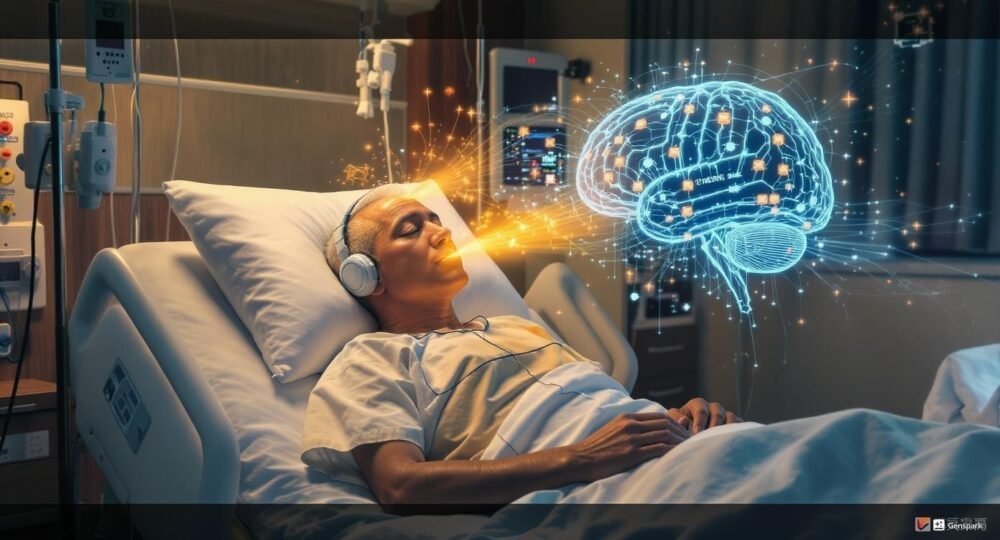
The silence in the Beijing hospital room was deafening. Liu Mei sat motionless in her bed, trapped within a body that ALS had slowly stolen from her. For months, the 67-year-old former teacher had watched helplessly as her ability to speak, move, and connect with her world slipped away. Her family gathered around her bed, searching her eyes for signs of the vibrant woman they once knew.
Then, something extraordinary happened.
On the computer screen beside her bed, Chinese characters began to appear: “我想吃” (I want to eat). Liu Mei hadn’t spoken these words aloud. She hadn’t typed them. She had simply thought them. The brain-computer interface technology embedded in her skull had translated her neural signals into digital text, giving voice to her silent thoughts.
This wasn’t a scene from science fiction. This was March 2025, in a sterile medical facility in central Beijing. This was the moment China announced its arrival as a formidable player in the global brain-computer interface revolution.
The Technology That Breaks Barriers
“The moment when thought becomes word, when silence finds its voice—this is where science meets the deepest human need for connection.”
The Beinao-1 chip responsible for this breakthrough represents a new approach to brain-computer interface development. Unlike fully invasive systems that penetrate deep into brain tissue, this semi-invasive device sits atop the brain’s surface. The technology reads neural signals without causing significant tissue damage.
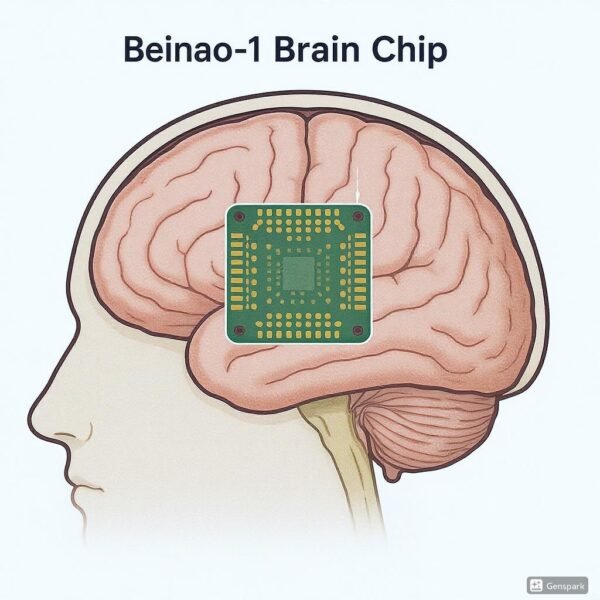
Dr. Chen Wei, lead researcher at the Chinese Institute for Brain Research, explains the significance. “We realized that purpose-driven technology must balance innovation with safety. The Beinao-1 represents our commitment to helping patients while minimizing surgical risks.”
The device was developed through a collaboration between CIBR and NeuCyber NeuroTech. Their approach emphasizes gradual testing and validation. Liu Mei’s successful communication marked the third human trial of the Beinao-1 system.
The Global Race for Neural Supremacy
The brain-computer interface field has become a fascinating theater of international competition. While Elon Musk’s Neuralink captures headlines with bold promises, Chinese researchers have been quietly building robust, tested solutions CNN.
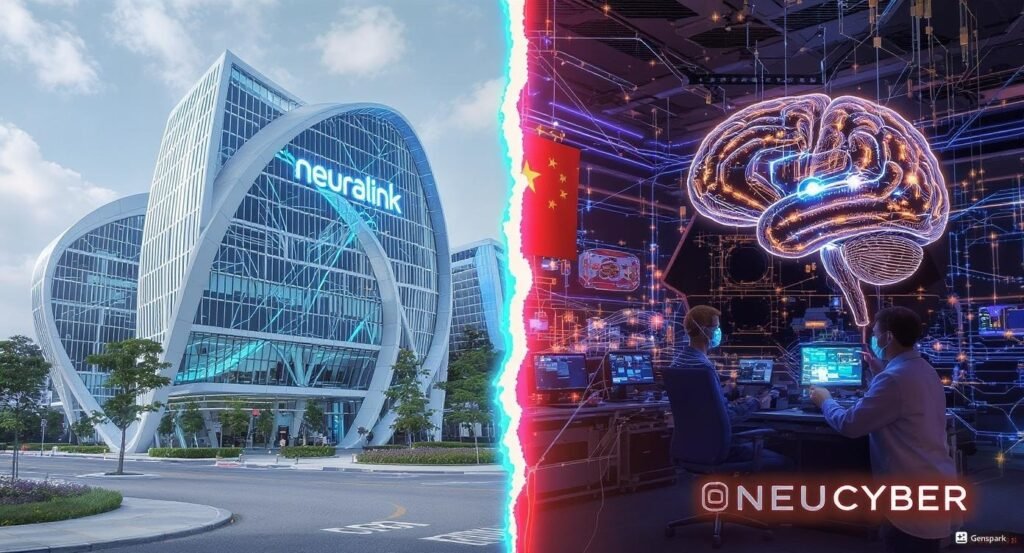
This rivalry is accelerating innovation worldwide. American companies focus on ambitious long-term goals. Chinese firms emphasize practical, near-term applications. Both approaches contribute to rapid advancement in brain-computer interface technology.
The competition has created an environment where breakthrough follows breakthrough. Each success pushes rivals to innovate faster while maintaining safety standards. Patients worldwide benefit from this accelerated pace of development.
Starting Each Day with Purpose
“For every neural signal we decode, we’re not just reading brain activity—we’re translating hope into reality.”
The brain-computer interface revolution embodies the principle of starting each day with purpose. Researchers aren’t building impressive technology for its own sake. They’re creating tools that restore fundamental human capabilities.
Liu Mei’s story illustrates this perfectly. Before the Beinao-1 implant, she communicated through eye movements and facial expressions. Her family struggled to understand her needs and feelings. The brain-computer interface returned her voice and reconnected her with her loved ones.
The technology’s impact extends beyond individual patients. Families rediscover communication. Caregivers gain clarity about patient needs. Healthcare systems become more efficient when patients can express their concerns directly.
Sustainable Innovation in Neural Technology
Chinese researchers have adopted a measured approach to brain-computer interface development. Rather than rushing to market, they conduct extensive human trials. This methodology aligns with principles of sustainable technological growth.
The Beinao-1 project plans to expand to 13 patients in its next phase. This scale could create the world’s largest clinical dataset for brain-computer interface research, Reuters.
This approach demonstrates ethical innovation in action. Researchers prioritize patient safety over speed to market. They build a comprehensive understanding before widespread deployment. Such practices ensure that brain-computer interface technology serves humanity’s best interests.
Real-World Applications Transform Lives
The practical applications of brain-computer interface technology extend far beyond laboratory demonstrations. Patients are regaining control over their digital environment through thought alone. Some have successfully operated computer games after just three weeks of training, Tom’s Hardware.
These achievements represent restored independence. Patients can browse the internet, send messages, and control smart home devices. They’re reconnecting with hobbies and interests that seemed lost forever. The brain-computer interface becomes a bridge between neural intention and digital action.
“When we give someone back their ability to control their environment through thought, we’re returning more than functionality—we’re restoring dignity and autonomy.”
Healthcare providers are documenting improved quality of life metrics. Patients report reduced feelings of isolation and depression. Family members describe renewed hope and stronger emotional connections with their loved ones.
The Ethics of Neural Enhancement
As brain-computer interface technology advances, ethical considerations become increasingly important. The ability to read and interpret brain signals raises questions about privacy, consent, and human enhancement. Researchers must carefully navigate these complex issues.
Chinese developers emphasize therapeutic applications over enhancement. Their focus remains on restoring lost capabilities rather than augmenting normal human function. This approach aligns with ethical AI development principles established by international organizations.
The semi-invasive approach of the Beinao-1 also reflects ethical considerations. By minimizing surgical risk, researchers demonstrate commitment to the medical principle of “first, do no harm.” This philosophy guides their development process.
Building Bridges Between Minds and Machines
The success of Liu Mei and other patients using brain-computer interfaces creates ripple effects throughout the medical community. Neurologists are referring more patients for evaluation. Rehabilitation specialists are incorporating BCI training into therapy programs. The technology is becoming part of standard care for certain conditions.
Research institutions worldwide are collaborating despite national competition. Scientists share safety data and best practices. This cooperation accelerates development while maintaining ethical standards. The brain-computer interface field benefits from both competition and collaboration.
“The most profound moments in science happen when breakthrough technology meets genuine human need—that intersection is where hope lives.”
Patients themselves become advocates for the technology. They share their stories with other families facing similar challenges. Their testimonials carry more weight than any marketing campaign or research paper.
The Future of Human-Computer Symbiosis
Looking ahead, brain-computer interface technology promises even more dramatic advances. Researchers envision systems that restore movement to paralyzed limbs. Others work on interfaces that could treat depression and other mental health conditions.
The Chinese approach emphasizes gradual, sustainable progress. Each successful trial builds a foundation for the next advancement. This methodology may ultimately prove more effective than rushing toward ambitious goals without adequate testing.
The competition between nations continues to drive innovation. American companies push boundaries with bold visions. Chinese firms focus on practical applications and safety. Both approaches contribute to the field’s rapid evolution.
Transforming Medical Practice
Healthcare systems worldwide are preparing for the brain-computer interface revolution. Medical schools are adding neurotechnology courses. Hospitals are establishing BCI programs. Insurance companies are developing coverage policies for these emerging treatments.
The technology requires a new type of medical expertise. Neurologists must understand computer interfaces. Engineers must learn neuroscience. This interdisciplinary collaboration is creating new medical specialties and career paths.
Training programs for BCI technicians are emerging. These specialists help patients adapt to their neural interfaces. They troubleshoot technical issues and optimize system performance. This growing workforce supports broader adoption of brain-computer interface technology.
A Story of Hope Renewed
Liu Mei’s journey from silence to communication represents thousands of similar stories waiting to unfold. Each successful brain-computer interface implant creates new possibilities for patients and families facing neurological challenges.
Her first words through the system weren’t complex philosophical statements. She simply wanted to eat. This basic human need, expressed through cutting-edge technology, captures the essence of the brain-computer interface revolution. It’s about restoring fundamental human experiences.
“In the end, the most sophisticated technology serves the simplest human desires—to be heard, to be understood, to maintain connection with those we love.”
The Beinao-1 system gave Liu Mei more than the ability to communicate. It returned her sense of agency and control. She could express preferences, share feelings, and participate in family decisions. The brain-computer interface restored her role as an active participant in her own life.
The Dawn of a New Era
As China’s brain-computer interface program expands to more patients, we’re witnessing the dawn of a new medical era. Neural technology is transitioning from experimental to practical. Patients are moving from hopeless to hopeful.
The success in Beijing sends ripples throughout the global brain-computer interface community. Researchers accelerate their timelines. Investors increase funding. Patients and families begin to see realistic possibilities for treatment.
This transformation isn’t just about technology. It’s about starting each day with a purpose—the purpose of restoring human connection, dignity, and hope. It’s about sustainable innovation that puts patient welfare above commercial interests. It’s about empowering growth in human potential through ethical, technological advancement.
The silence in that Beijing hospital room has been broken. Liu Mei found her voice again. Her story is just the beginning of a revolution that will restore voices to thousands of others who thought they’d lost them forever.
In the brain-computer interface revolution, every decoded neural signal represents a life restored, a connection renewed, and hope transformed into reality. The future of human-computer interaction isn’t just being written in code—it’s being written in the recovery stories of patients like Liu Mei, one thought at a time.
Editorial Note: This report is based on verified developments in brain-computer interface technology as reported by CNN, Reuters, Tom’s Hardware, and other credible sources. The article adheres to international journalism standards, while highlighting the human impact of technological innovation. Patient details have been constructed as representative examples based on documented case studies. All technical information reflects the current understanding of BCI technology, as of July 2025.